A Chinese ‘honorary tapestry’ in the Limburg Mission Museum in Steyl
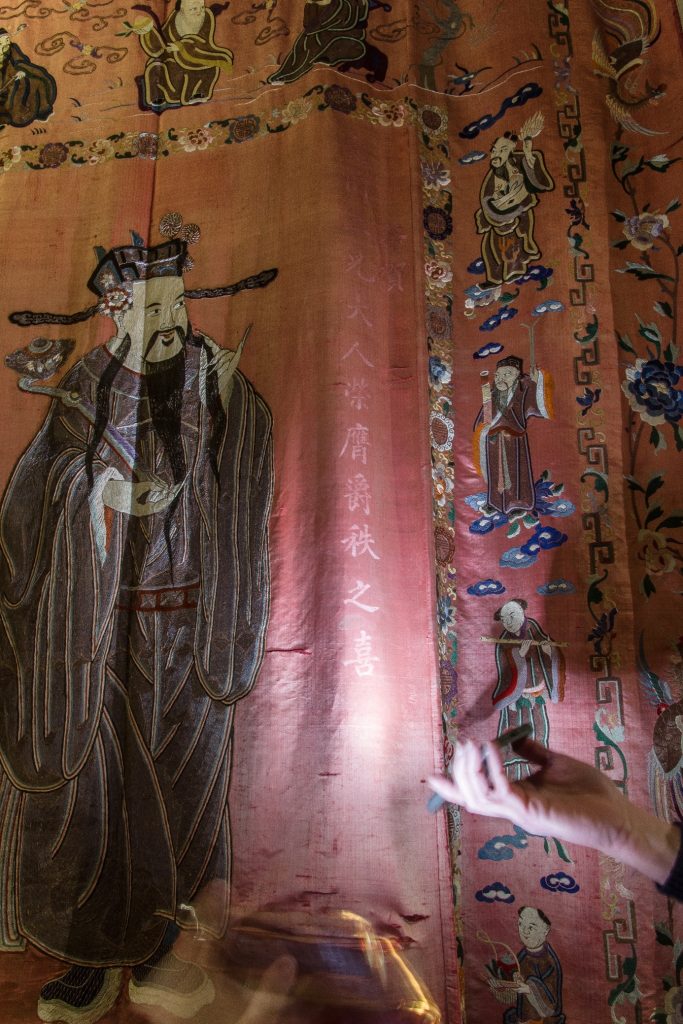
Over the past year, various institutions have carried out research with support from the Colonial Collections Provenance Research Scheme run by the Colonial Collections Consortium. The Mission Museum Steyl provides a notable example of such research: there, the provenance of a Chinese honorary tapestry – which became part of the collection under circumstances that are not entirely clear – has been investigated.
The tapestry was given to the Chinese general and administrator Tianjue Zhou in the mid-nineteenth century. In 1901, it came into the possession of the missionary Anton Volpert of the SVD congregation in Steyl – a period coinciding with the aftermath of the Boxer Rebellion (1899–1901), when widespread looting took place in China. It is therefore suspected that this object was taken by force or through looting.
Research into meaning and context
With financial support from the Colonial Collections Consortium, the museum investigated step by step how this textile came to be in Steyl. The research focused on questions such as:
- How did the SVD come to be in possession of the tapestry?
- What was the function and symbolic meaning of the object within its original Chinese context?
- And how did the missionaries subsequently give it a new, religious or museum-related role in Steyl?
The research was carried out in collaboration with PhD student Yang Hu from Leiden University. Her knowledge of the Chinese language and culture proved to be of great value: on closer examination of the tapestry, faded characters were discovered in the margin, which became visible again when illuminated with raking light. Yang translated and interpreted these characters, which may offer insight into the object’s original status and meaning.
Little-known colonial links
What makes this research special is that it sheds light on a relatively unknown period of German colonialism in China, during which the SVD was active. At the time, the missionary congregation played a role in fuelling the Boxer Rebellion. At the same time, the research helps to explain why such objects were collected by missionaries and subsequently exhibited in Steyl. For today’s visitors, this provides new context and critical insight into the colonial history of the collection.
The added value of collaboration
The project illustrates the importance of collaboration in ensuring the careful handling of collections from a colonial context. The Colonial Collections Consortium works with museums, research institutions and archives to gain new insights into the provenance of colonial artefacts. We share expertise and research methods, and make funding available, so that even smaller institutions – such as Mission Museum Steyl – can carry out in-depth research into the colonial connections within their collections.
Would you like to find out more about the role of missionaries in colonised territories? The NIOD has developed digital research aids for the Colonial Collections Consortium, which also includes collections such as that of the Mission Museum in Steyl. These research aids provide tools for researchers and members of the public who wish to gain a better understanding of colonial objects and their stories.