Relief plaque from the Benin Kingdom
Provenance research blog #5
In the blog series of the Consortium Colonial Collections, we present a historical object or collection from a former colonial context or situation, currently (or until recently) stored in a museum in the Netherlands that has been the focus of provenance research. Each blog explains the steps taken by the respective museum or external provenance researcher to carry out the research. Which stories lie behind the object and what can they tell us about the Dutch colonial past?
In focus this time: a relief plaque from the Benin Kingdom in Nigeria
The Benin Bronzes and the restitution debate
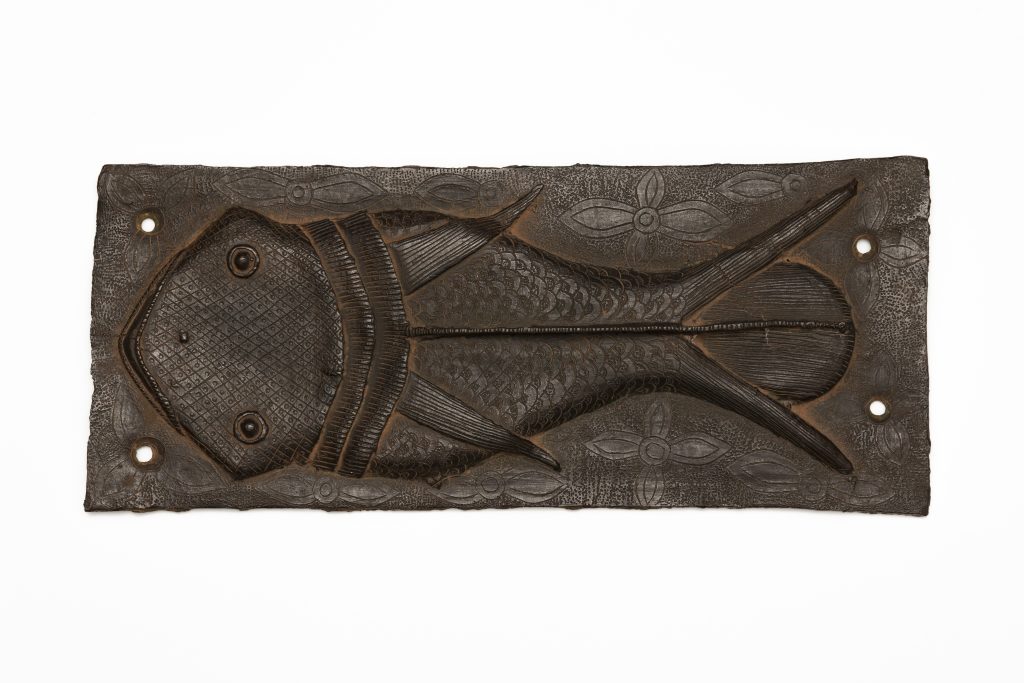
In this blog, we zoom in on a single item – a cast bronze plaque showing a relief representation of a mudfish. This item is part of the large and scattered collection of royal artefacts from Benin Kingdom (today within the Edo State in Nigeria) that were looted in the late nineteenth century. These historic objects – known collectively as the Benin Bronzes – are an expression of Benin culture, history and arts. They were created by specialist guilds working for the royal court of the Oba (king) in Benin City, in what is today Nigeria. The Benin Bronzes include, for example, elaborately decorated cast plaques, commemorative heads, animal and human figures and personal ornaments. They were made from at least the sixteenth century onwards and originally used as royal representational arts to portray historical events, to worship and to perform rituals. These objects were looted by British forces from the Benin Kingdom in 1897 and were distributed all over the world following this violent military campaign.
The Benin Bronzes have gained a lot of attention in recent years as they have been at the centre of debates in Europe about reckoning with its colonial past and the need to return the many historic belongings that were taken to European museums at that time, often under violent circumstances. Although seemingly recent, the current debate about restitution in Western contexts is preceded by a decades-long process that includes countless efforts from formerly colonised communities and countries to recover their historic belongings and ancestral remains. According to Eiloghosa Oghogho Obobaifo’s brief chronology, efforts to restitute the Benin Bronzes can be traced back at least to the 1960s. Bénédicte Savoy traces these and many other restitution efforts across the African continent in her recent book Africa’s Struggle for Its Art.
The situation seems to be slowly shifting, with European countries increasingly willing to return some of the belongings looted in colonial times. For instance, and following the initiative of other countries, the Netherlands returned 119 Benin Bronzes in the summer of 2025 to the Nigerian government.
Shifting the scope of provenance research
The relief plaque (or Ama in Edo) representing a mudfish was until recently part of the collection of Museum de Fundatie in Zwolle, in the Netherlands. This museum’s collection of more than 11.000 objects is composed of several, mainly private, collections. The basis was laid by Dirk Hannema (1895-1984), an art expert and the initiator of the Hannema-de Stuers Foundation, the origin of Museum de Fundatie. Before being forcibly removed, the relief plaque would have been part of the ornamentation of the Oba’s royal palace in Benin city.
Initially, provenance research in the Netherlands (as in other contexts) focused mainly on objects that had been forcibly expropriated during the period 1933-1945. Between 2009 and 2013, Museum de Fundatie was part of a national project organised by the Dutch Museums Association (Nederlandse Museumvereniging) to establish whether objects in collections were connected to this history. In this context, the provenance of the Benin Bronze of Museum de Fundatie was only investigated in relation to the period 1933-1945. This was done by examining the collection database, the museum’s archives and other sources.
In 2020, the debate about the restitution of colonial collections gained renewed attention in Europe, leading the museum to unearth further information about the origins, authenticity and provenance of the object. The relief plaque’s history had thus far only been traced up to 1937. What was already known about the origin of the plaque? A note by the founder of Museum de Fundatie, Dirk Hannema, showed that he had bought the relief in 1937 through art dealer Carel van Lier in Amsterdam, who had the item on loan from part of a display from Paris dealer Charles Ratton. Archival research revealed that a bas-relief of a fish bearing a strong resemblance to the Museum de Fundatie’s plaque was sold by auctioneers Messrs. Foster of Pall Mall, London on 26 June 1930. It is suspected that Ratton acquired the item there. The auction catalogue states that it came from the collection of a ‘gentleman’ and had previously been shown at the Brighton Museum (now Brighton & Hove Museums). This supports the hypothesis that the piece might have ended up in the UK via a British officer who may have been involved in the looting in 1897.
A material approach to provenance research
Since archival research was unable to provide further information about the provenance of the relief plaque, the museum decided to subject it to technical analysis in July 2025. An XRF (X-ray fluorescence) scan, which is a non-destructive analytical technique used to determine the elemental composition of materials, such as metals, plastics, or soil, showed that the plaque is made of brass, with no traces of nickel. This fact strengthened the possibility that this is a historical piece produced in Benin, rather than a modern reproduction. Subsequent chemical analysis on a small sample revealed that the metal consists of brass with small quantities of lead and tin, a composition that corresponds to the brass used in Benin and in European manillas — horseshoe-shaped pieces of metal used primarily as a form of currency. The lead isotope ratios also bear a strong resemblance to those of manillas from an eighteenth-century shipwreck found off Cape Cod, further confirming the origin of the piece. Although it is still not possible to determine with certainty how the relief plaque ended up in Paris after having been looted in 1897, the material analysis was able to confirm the origins of the bronze plaque in the collection of Museum de Fundatie.
Reflection
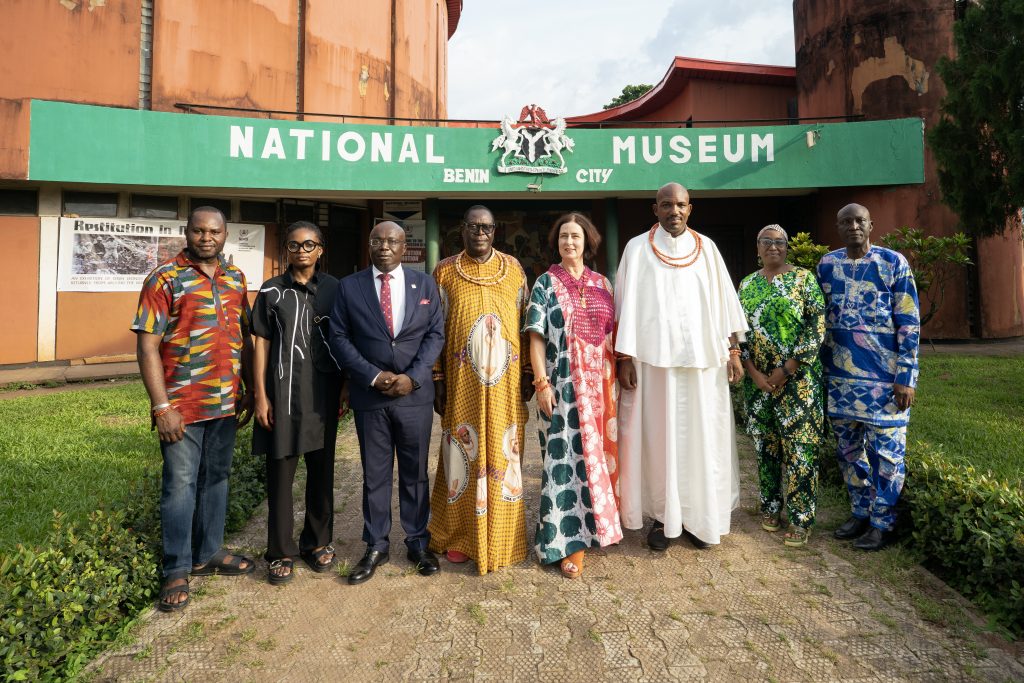
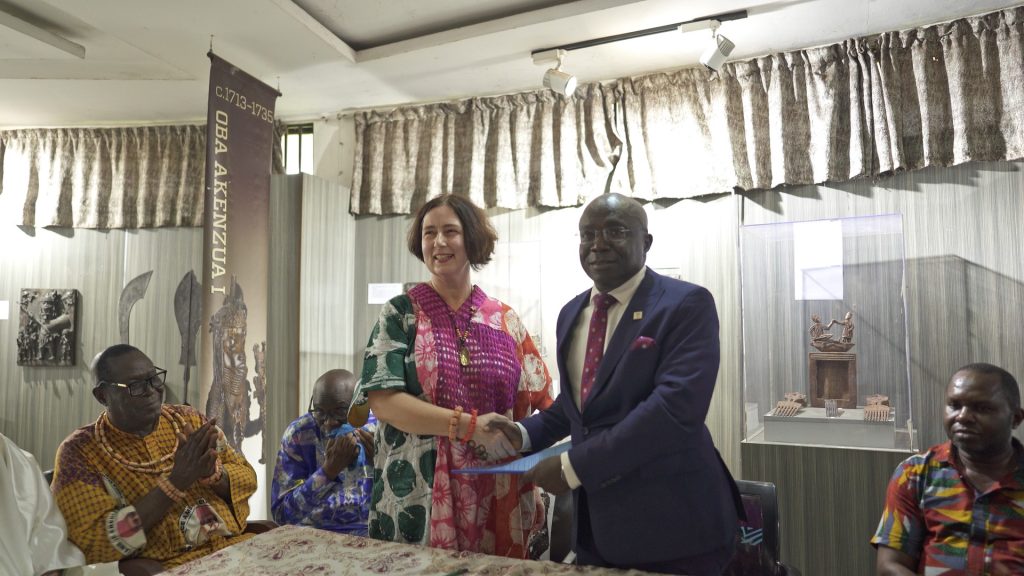
In this blog, we explored how shifting societal debates about the colonial past can influence the way in which museums view and research their collections. Furthermore, the case presented here showed that in some cases, material analysis of historical objects or collections can answer questions that archival research is unable to verify with certainty. Given the conclusions of the provenance research, Museum de Fundatie returned the relief plaque to the Royal House of Benin in November 2025. Furthermore, the plaque was renamed Ama O Ghe Ehen (plaque of a fish) and this is how it is referred to now, thanks to initial research by Osaisonor Godfrey Ekhator-Obogie.
In 2026, the museum opened an exhibition curated by Aude Christel Mgba (Curator of Contemporary Art), on the occasion of this restitution. Titled Back To Benin – New Art, Ancient Legacy, it brings together 10 contemporary Nigerian artists of Edo origin whose work, inspired by the plaque, engage in a dialogue with history, symbolism and cultural memory. More specifically, the exhibition shows the work of Osaze Amadasun, Minne Atairu, Leo Asemota, Victor Ehikhamenor, Taiye Idahor, Favour Jonathan, Osaru Obaseki, Enotie Ogbebor, Abraham Onoriode Oghobase and Phil Omodamwen. After the end of the exhibition, the Ama O Ghe Ehen will also return to Benin City physicially.
The provenance research into the relief plaque was financially supported by the Colonial Collections Consortium.
Final words
To better understand the historic and current meanings of objects, and how to ethically care for them, information about their origin and acquisition histories are essential. Provenance research is an ongoing process for museums. The Colonial Collections Consortium supports institutions that manage collections with this work by sharing knowledge and information, and by offering stakeholders a network. Would you like to know more or share information with us? Please contact us!
References and further reading
The provenance research presented in this blog was carried out by Kristian Garssen, Johan Koers and Aude Christel Mgba and the report was published in the catalogue of the exhibition Back To Benin – New Art, Ancient Legacy at Museum de Fundatie. The information presented in this blog derives from this research, as well as email communication with Aude Christel Mgba.