A toad and a photograph from Suriname
Provenance research blog #6
In the blog series of the Consortium Colonial Collections, we present a historical object from a former colonial context or situation, currently stored in a museum in the Netherlands that has been the focus of provenance research. Each blog explains the steps taken by the respective museum or external provenance researcher to carry out the research. Which stories lie behind the object and what can they tell us about the Dutch colonial past?
This time in focus: a toad and a photograph from Suriname
Brief historical introduction
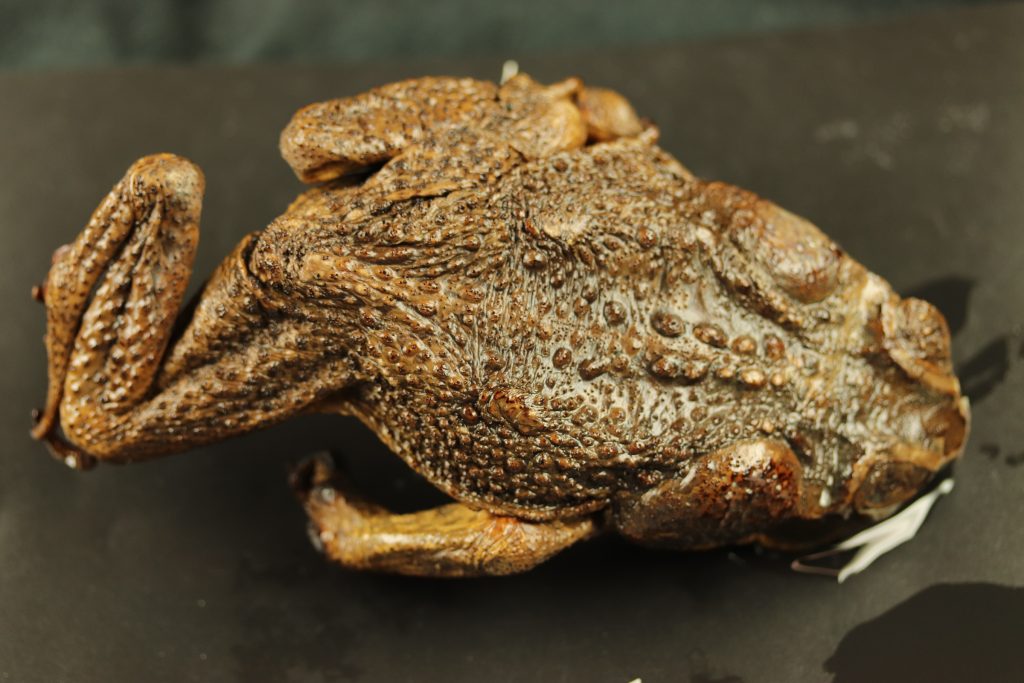
This blog focuses on a toad specimen kept at Naturalis Biodiversity Center (RMNH.RENA.29133) and a historical photograph stored at the Wereldmuseum (RV-A103-1-83). These two items, housed in different museums, have been examined in the context of broader research on the role of Indigenous and Maroon individuals in Suriname in the creation of natural and ethnographic collections currently housed in the Netherlands. It aims to reflect on the biases of the colonial archive and showcase the role that provenance research can play in developing more complete histories, in this case of scientific exploration in Suriname.
Both the toad and the photograph were taken from/in Suriname on the same day – 12 September 1904 –, in the context of a series of expeditions commissioned by the Royal Dutch Geographical Society (Koninklijk Nederlands Aardrijkskundig Genootschap or KNAG). Namely, the Coppename (1901), Saramacca (1902), Gonini (1903), Tapanahoni (1904) and Toemoekhoemak (1907) expeditions. The KNAG was founded in 1873 to advance research on world geography. This took place at a time when many scientific societies were being created in the Netherlands and other European countries, driven by ambitions of development and progress. During the nineteenth and twentieth century, the KNAG organized several expeditions to map territories then occupied by the Netherlands. These also involved the collection of plants, minerals, and animals, as well as cultural belongings, with the goal of developing knowledge about these contexts, its peoples and exploring their commodification potential.
Reading against the (colonial) grain
The knowledge developed during these expeditions is largely attributed to the Dutch individuals involved. Namely, military officer Alphons Franssen-Herderschee, Gerard Versteeg, a medical student and expedition doctor, and Claudius Henricus de Goeje, a Royal Dutch Navy cartographer, all three of which participated in the Gonini and Tapanahoni expeditions. However, recent and ongoing research carried out by researchers affiliated with the Naturalis Biodiversity Center – namely Caroline Fernandes Caromano, Inez de Ruiter, Tinde van Andel, Mariana Françozo, Daan Zielinski e Chamul Sardjoe – has been showing that this perception is linked to biases and erasures in the colonial archives.
The researchers have been carrying out provenance research of natural history and ethnographic collections in ways that reveal the Indigenous and Maroon perspectives and experiences, therefore challenging the dominant narrative of scientific exploration in Suriname during the early twentieth century. As they are written solely by the Dutch expedition members, the Dutch sources are biased, often reflecting racial prejudices and offering narrow perspectives on the experiences of the local laborers. Nonetheless, a critical analysis of these sources can uncover important insights. As such, the researchers have been able to unravel a more accurate and complete history of scientific exploration in this context, revealing that these expeditions depended heavily on local laborers, namely Afro-Surinamese (both Maroons and workers from Paramaribo) and Indigenous individuals. Their knowledge of the regions being explored was crucial for the survival of the teams as well as for the development of knowledge and the collection of natural specimens and artefacts now housed in Dutch museums.
Provenance research
In recent years, provenance research has increasingly been looking into microhistories, allowing for the development and dissemination of more complete (colonial) histories. In this case, the researchers have been examining the official reports written by the expedition leaders, as well as their diaries, which provide a more personal view of the experience, including details about interactions and relationships with local laborers. Correspondence is also used to confirm or challenge accounts from these diaries. A digital archive of photographs from the expeditions currently kept at the Wereldmuseum and Leiden University Libraries has been complementing the written documentation, as these photographs help to illustrate the events and the individuals described in the written accounts. Finally, in some cases, the labels on the items themselves can provide unexpected information. That is the case with the toad examined in this blog.
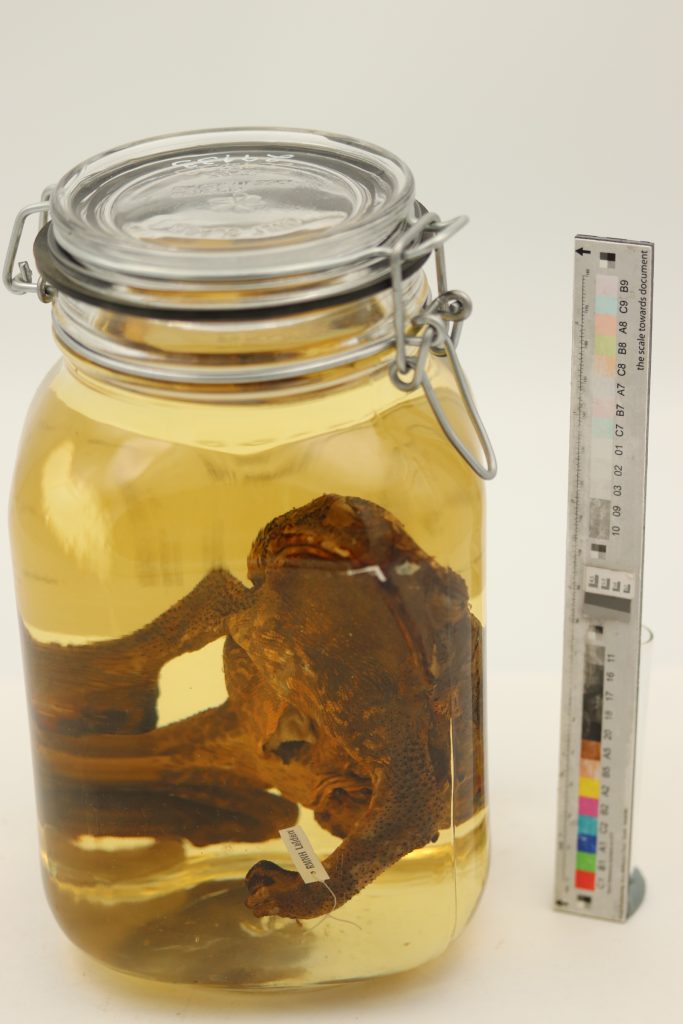
The toad is of the Bufo marinus species (Linnaeus, 1758), its current nomenclature is Rhinella marina (Linnaeus, 1758) and it is commonly known as cane toad and giant toad. Although scientific knowledge is often seen as ahistorical, neutral and universal, it is – similarly to the official reports describing scientific expeditions at the beginning of the twentieth century – the product of historical, political and social contexts. The use of Latin, for instance, stems from the fact that when the Swedish biologist Carl Linnaeus developed his classification system in the eighteenth century, it constituted the lingua franca of educated Europeans, therefore becoming the basis for naming the natural world. Furthermore, natural elements like plants, animals, rivers and mountains were often named after the European men who supposedly discovered them. For example, two of the species collected during the Gonini expedition were named after Versteeg – the Arthrosaura reticulata versteegii and the Laelaps versteegi.
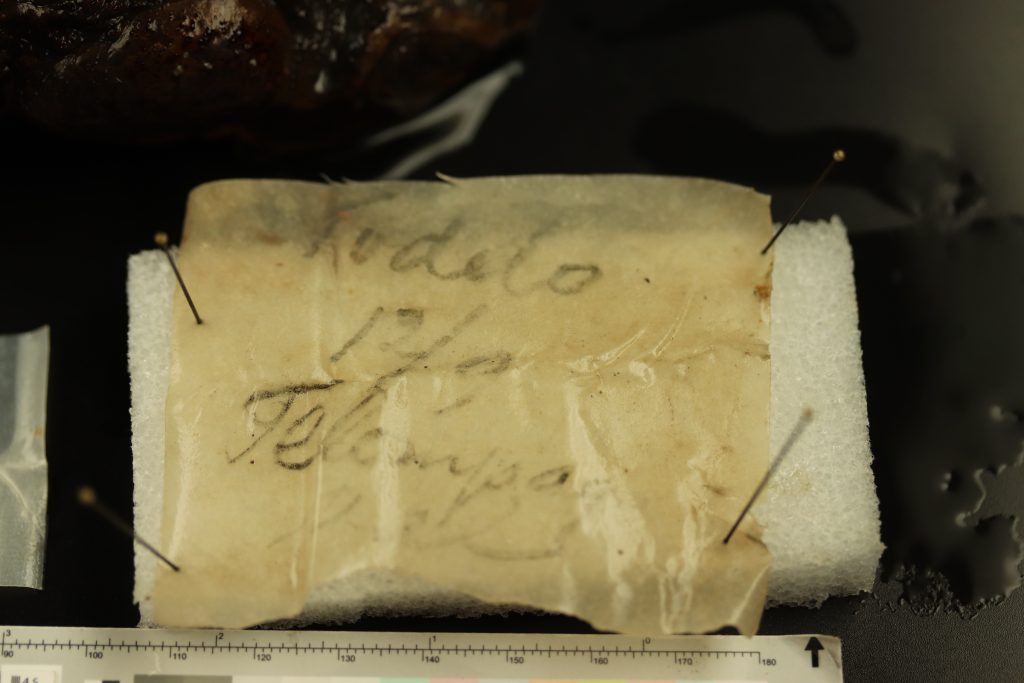
The toad’s internal record at Naturalis includes the date of collection – 12 September 1904 –, which demonstrates that it was collected during the Tapanahoni expedition. The main goals of this expedition were to map the Tapanahoni River, explore the Suriname River and acquire ethnographic collections, particularly from the Wayana and Trio communities. The label which was preserved in alcohol together with the toad includes the date, as well as the local name used for the toad – “Toddo” – in Sranan Tongo, the creole language of Suriname. The label also includes the word Telompaga which, according to the report written in 1905 by Franssen-Herderschee (“Verslag van de Tapanahoni-Expeditie”), is the Indigenous name (possibly of the Wayana people) for an area of rapids on a section of the Paloemeu River, which joins the Tapanahoni River at the village of Paloemeu. Franssen-Herderschee also mentions in his report that the Maroons call this place “Trombaka”, meaning area of return, because it’s an area with a lot of rocks, rapids and waterfalls and, therefore, of difficult access, where boats were often not able to pass. This information together already suggests that Maroon and Indigenous individuals were involved in this expedition.
From the archival research carried out by Caroline Fernandes Caromano and her colleagues, we know that the Tapanahoni expedition employed 28 individuals, mainly Afro-Surinamese laborers (unless mentioned otherwise in the following sentence). Their names were Copijn, Andreas, Koffie, Soekroe, Karel, Madonné, Paté (guide), Malo (guide), Sully (cook), Madretsma (second cook), Sindélé, Sako, Makandro, Akrosi (grandson of Oseisi) (guide/translator), Sonie (guide/translator), Melchiot, Roozendaal, Dens, Leeflang, Heerde, Henze, Teboe, Lebitetei, Abaaitong, Brandon, Ho-a-Hing (Chinese), Johannes (Indigenous, Kali’na), William (Indigenous, Kali’na).
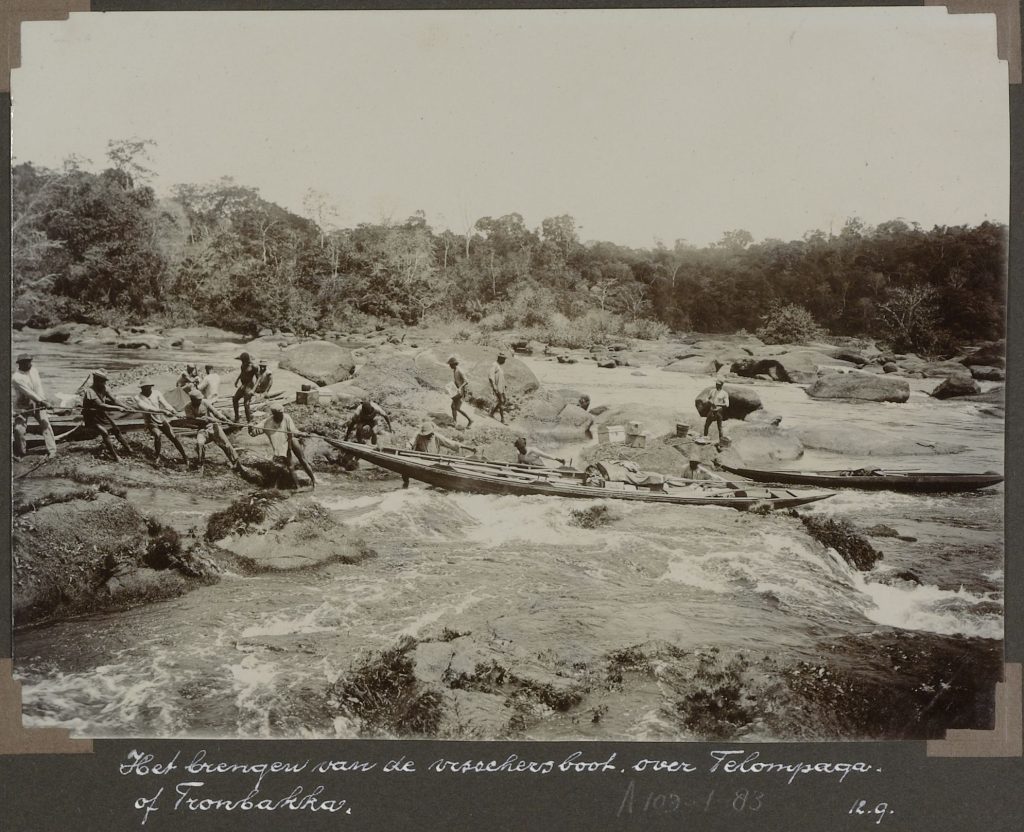
The photograph mentioned earlier and shown above, which is also dated to 12 September 1904, demonstrates the huge difficulty that these men had to cross the Telompaga part of the Paloemeu River. It shows them pulling boats and carrying boxes with the expedition’s equipment and the collected materials. By bringing archival sources about the Tapanahoni expedition together with this historical photograph as well as the preserved toad itself, it is possible to build quite a detailed perspective about who was involved, some of the challenges they faced and their crucial contributions to the expedition.
Reflection
This blog draws on recent research carried out on natural history and ethnographic collections to show how provenance research can help rectify certain biases and challenge dominant narratives of scientific exploration in Suriname. The combined analysis of diaries and direct object analysis of distinct collections offers a depiction of local people who were previously erased from the official narrative. The deep knowledge of Indigenous and Maroon individuals of the local environment and their ability to guide Dutch scientists in locating, collecting and identifying plants and animals, as well as the agency of local leaders in facilitating the access and exchanges between the Dutch researchers and local communities, was essential for the creation of the collections now housed in Dutch museums. Local collectors and their indispensable role have been identified through provenance research, and their names should therefore be recognized and included in the records of ethnographic and natural history collections.
In this final section, we also reflect on another issue represented by museums such as Naturalis and Wereldmuseum Leiden, and which can sometimes become a challenge to provenance research. According to Western science principles, natural elements relating to plants, animals and earth systems are seen as “specimens” and are traditionally housed in natural history collections, whereas human-made objects constitute “artefacts” and are placed in ethnographic or world cultures collections. However, and as scholars and museum professionals such as Jack Ashby have argued – and as the research presented here shows – this nature-culture division is artificial. Natural specimens were and continue to be usually prepared by people for long-term preservation, and therefore could also be seen as artefacts, while artefacts are often made from natural materials, and therefore include specimens. Furthermore, although materials collected in colonial times often ended up in different kinds of collections – such as those of Naturalis and of Wereldmuseum – they were often collected by the same people, in the same places, at the same time, being divided only when arriving in Europe. By examining a toad and a photograph taken on the same day yet kept in different kinds of institutions, this blog shows that bringing together collections and corresponding documentation from different institutions can also contribute to better understanding colonial (collection) histories, as well as the histories of the institutions that house them today.
Final words
To better understand the historic and current meanings of objects, and how to ethically care for them, information about their origin and acquisition histories are essential. Provenance research is an ongoing process for museums. The Colonial Collections Consortium supports institutions that manage collections with this work by sharing knowledge and information, and by offering stakeholders a network. Would you like to know more or share information with us? Please contact us!
References and further reading
This blog was written by Sofia Lovegrove. The information presented in this blog derives from the article “Surinamese maroon and indigenous knowledge in the creation of natural and ethnographic collections housed in The Netherlands” written by Inez de Ruiter, Tinde van Andel, Mariana Françozo and Caroline Fernandes Caromano in 2025. Further research will be published soon in an article written by Ruiter and Caromano, titled “Looking Beyond Knives, Buttons and Beaded Aprons: Indigenous and Maroon Agency in Colonial Collecting Practices and the Provenance of 10 Surinamese Objects in The Netherlands” (in the journal Museum International). The specific information about the toad derives from email communication from Caromano and the research she has been carrying out in collaboration with students Chamul Sardjoe (Anton de Kom Universiteit van Suriname) and Daan Zielinski (Utrecht University), which will be expanded in the project “Provenance Research of early twentieth century Surinamese botanical and zoological collections housed at Naturalis”, funded by the Colonial Collections Consortium. The provenance research started with Caromano’s Veni Project titled “Seeds in Amazonian Body Ornaments: Encapsulated Indigenous Histories, Aesthetic and Environmental Knowledge” (2021-2024), and is currently taking place in the context of the NWA Consortium “Epistemologies: The Reinterpretation of Existing Traditional Knowledge in Suriname” coordinated by Dr. Cheryl White (Anton de Kom Universiteit van Suriname). Both projects were financed by the Dutch Research Council (NWO). The article written by Jack Ashby is titled “The Entwined Human and Environmental Costs of the Colonial Project” and was published in 2024.