Four museums receive a grant from the Colonial Collections Consortium for provenance research, contributed through the Provenance Research Scheme. With this grant, they will investigate the provenance histories of a (sub)collection or a specific object for which there are indications that it was acquired in a colonial context.
Awarded projects
Read more about the awarded projects below.
Chabot Museum (€25.570)
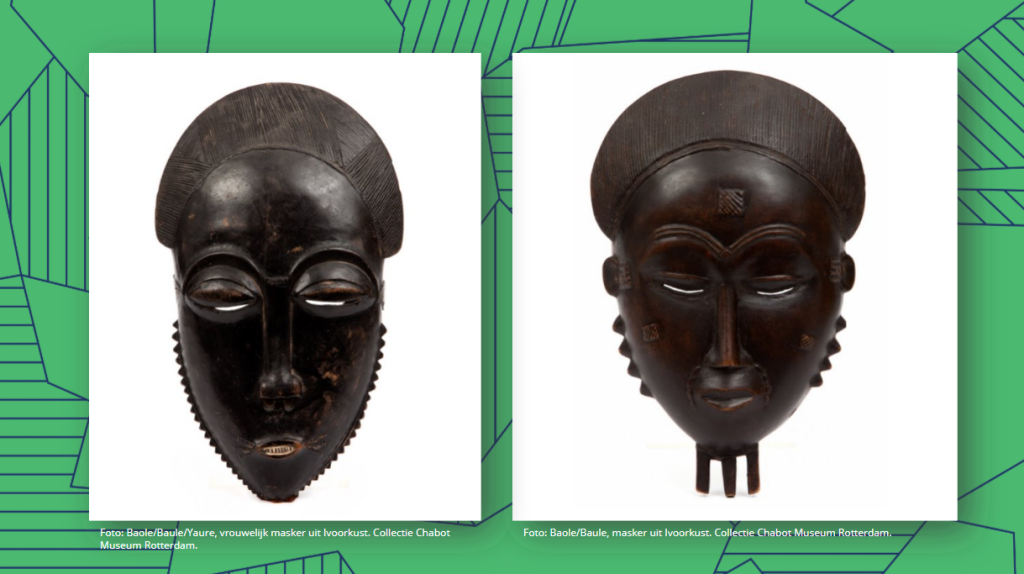
Chabot Museum will research the provenance of approximately 22 etnographic objects from West-Africa, from the collection-Schortenmeijer. The project focuses on transparency about the provenance, acquisition and colonial context, and aims to provide a more careful and honest presentation of the collection. Focus is given to, among other things, archives, art trade networks and posisble countries of origin, such as Ivory Coast.
Museum Gouda (€17.400)
Museum Gouda, founded in 1874 and grown into a collection of more than 40.000 objects, researches two specific objects with unknown provenance. The research concerns a unique ivory pipe case from Sri Lanka and a porselain spittoon from Curaçao, gifted in 1967. Through archival research, object analysis and literature, the provenance histories of these objects will be reconstructed.
Naturalis Biodiversity Center (€27.030)
Naturalis will research the provenance of botanical and zoological collections collected during Dutch expeditions in Suriname in the early 20th century. Central to this research is the role of Indigenous and Marron-communities, who actively contributed to the collection of objects and the production of knowledge. Through archival research and diary and specimen analysis, hidden traces of local knowledge and collaboration will become visible.
Westfries Museum (€30.000)
As part of a broader renewal of its museum presentation, the Westfries Museum will examine its collection within a global, inclusive context. Within a revaluation process of in total 36.000 objects, the colonial provenance of a selection of 30 objects from the Carbasius-collection (1650-1750) will be studied. The focus is on archival sources, objects analysis, and possible connections with the VOC and colonial trade networks. Aim is to make this context more visible and to integrate it into a renewed presentation.
10 September 2025
The Provenance Research Scheme by the Colonial Collections Consortium contributes to eleven museums that will investigate the provenance history of their (sub)collection or a specific object for which there are indications that it was acquired in a colonial context. The Provenance Research Scheme made a total of €500.000 available for such research. In this second round of applications, €256.683 has been awarded. The second round was the last round for the Provenance Research Scheme.
Awarded projects
Read more about the awarded projects of the second round below.
Beeld en Geluid (€24.000)
Beeld en Geluid is conducting research into three Sticusa-films (Stichting Culturele Samenwerking Suriname en de Nederlandse Antillen/Foundation for Cultural Cooperation) from the 70s, to indicate their provenance and context. The films will be returned to the people in Suriname and the Antilles, and will be made available for education, so they can serve as a tool for reflection and dialogue about (post)colonial relations.
Universiteit Leiden (€10.000)
Prof. dr. Ben Arps (Leiden University) conducts provenance research into eleven unique maps from Java, from 1825. They depict the districts of the regency of Semarang and are currently part of the collection of the National Archives. Their creators, purpose, and journey to Europe are unknown. Analysis of style, language, and context should reveal their provenance and shed new light on their colonial heritage.
Universiteitsmuseum Groningen (€13.749)
The Universiteitsmuseum Groningen conducts provenance research into the sub-collections of Gerardus van der Leeuw, in particular, religious and ritual objects from missionary and colonial networks. The project focuses on unknown provenance, ethical acquisition, and the context of collections, in addition to digital access and publication of the findings to science and the public.
Boijmans van Beuningen (€30.000)
Boijmans van Beuningen conducts provenance research into the sub-collection of Dr. Johan C.J. Bierens de Haan (1883-1958), the objects were collected from Tibet, China, Iran and Japan (1909-1920). The research focuses on the context of collection, the political situation of the region and the possibly problematic provenance of the objects.
Rijksmuseum Boerhaave (€27.360)
Rijksmuseum Boerhaave researches the sub-collection of Jan van der Hoeven (1801-1868), in which his scientific work and colonial context are visible. The research focuses on the provenance of zoological and physical-anthropological collections, including objects and portraits, and explores how the Dutch colonial expansion shaped his scientific activities.
De Mesdag Collectie (van Gogh Museum) (€23.980)
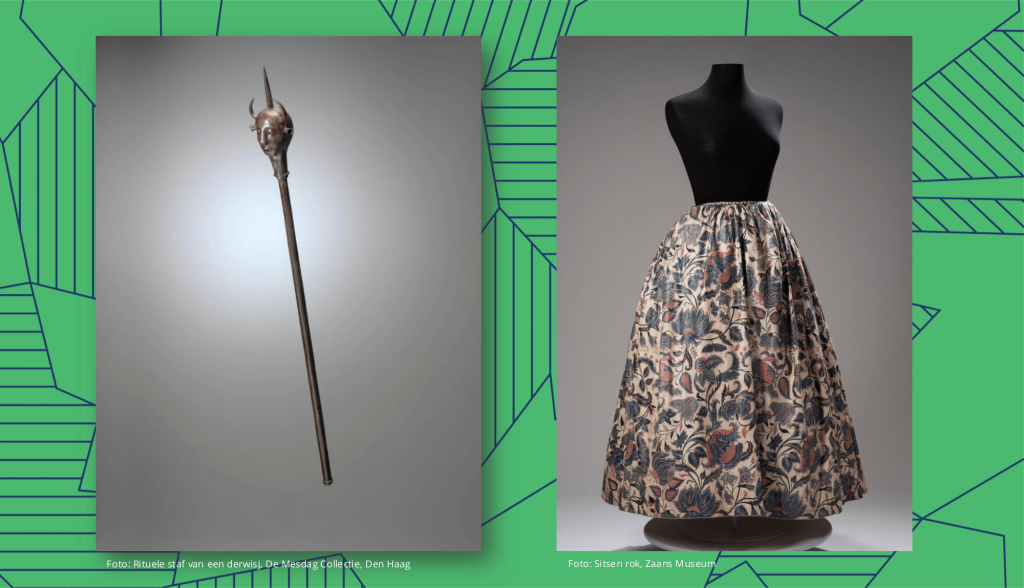
This project conducts research into circa 80 Indonesian objects that are suspected to have been acquired from a colonial context, such as temple and ancestral statues, weapons, and architectural fragments. The goal is to trace their provenance, reconstruct the context of removal, and identify possible restitution claims, using experts and specialist provenance research.
Keramiekmuseum het Princessehof (€30.000)
This project conducts research into circa 80 Indonesian objects that are suspected to have been acquired from a colonial context, such as temple and ancestral statues, weapons, and architectural fragments. The goal is to trace their provenance, reconstruct the context of removal, and identify possible restitution claims, using experts and specialist provenance research.
Zaans Museum (€18.170)
The Zaans Museum conducts research into eighteenth- and nineteenth-century clothing made out of chintz to establish the colonial provenance of the fabrics. By making a distinction between Indian and European chintz, insights are given into production, trade routes of the VOC and the role of these clothes in the Zaan identity.
Museum Catharijneconvent (€20.000)
Museum Catharijneconvent researches the colonial context of mission objects. The project studies inculturation, colonial provenance of materials, and ownership, with attention to local creators and power relations. This is intended to give insight into cultural exchange, religious influence, and the connections between Christianity and European colonialism.
Allard Pierson (€29.986)
Het Allard Pierson researches the Houbolt-collection. These objects were collected from Indonesia, New Guinea, and Malaysia. The project explores in what ways the objects were collected, by whom, and under which circumstances. Additionally, the project explores whether the objects present a case of involuntary loss, in collaboration with the Universitas Gadjah Mada.
Missiemuseum Steyl (€29.436)
Missiemuseum Steyl conducts research into objects of the collection of the Mission Sisters of the Servants of the Holy Spirit. This research focuses on a Japanese Buddhist household shrine. By tracing the provenance, the project aims to give insights into the connection between imperialism, missionary work, and colonialism and to contribute to the decolonization discussions outside of museum and national collections.
On 15 July 2025, the second round of applications for the ‘Regeling Herkomstonderzoek Koloniale Collecties,’ was closed. The assessment committee will gather shortly to assess all the received applications.
Members of the assessment committee:
- Mirjam Hoijtink, Head of Research & Collections, Wereldmuseum
- Karel Weener, provenance researcher, History Department, Rijksmuseum
- Klaas Stutje, senior researcher affiliated with the Expertise Center Restitution, NIOD Institute for War-, Holocaust- and Genocide Studies.
- Pauljac Verhoeven, director, Museum Bronbeek
15 May 2025
The Provenance Research Scheme by the Colonial Collections Consortium contributes to ten museums that will invastigate the provenance history of their (sub) collection or a specific object for which there are indications that it was acquired in a colonial context. The Provenance Research Scheme makes a total of €500.000 available for such research. For the first round of applications, €243.317 has now been awarded. The second and final round of applications closes on 15 July 2025.
Awarded projects
Read more about the awarded project of the first round below.
Keramiekmuseum het Princessehof, Leeuwarden (€30.000)
This provenance research focuses on the non-ceramic Indonesia collection “Indische Kunst”, which was collected by Nanne Ottema, the founder of the Ceramics Museum.
Kunstmuseum Den Haag (€30.000)
Kunstmuseum Den Haag is conducting research into the eighteenth-century court silver of the Sultan of Ternate from the precious metal collection and two nineteenth-century Indonesian gongs from the music collection.
Missiemuseum Steyl (€27.980)
This provenance research that will be carried out revolves around an honorary robe with Baxian motifs from Yanggu (China) that was brought by missionaries in 1901 under unclear circumstances.
Museon-Omniversum, Den Haag (€7.610)
The Museon-Omniversum is investigating the kwakwabangi, a unique bench from Suriname from around 1850. It was an important symbol of one of the Du companies and is, as far as we know, the only example in the world.
Museon-Omniversum, Den Haag (€7.610)
The Museon Omniversum is investigating the kwakwabangi, a unique wooden bench from Suriname that was used as a percussion instrument by the Du companies. The object dates from around 1850 and is, as far as we know, the only example in the world.
Museum de Fundatie, Zwolle (€30.000)
This museum has a Benin Bronze in its collection. It was probably stolen from the Kingdom of Benin in 1897. It has been part of the collection since 1937 through founder Dirk Hannema.
Museum Prinsenhof Delft (€30.000)
The museum will examine twelve objects from the Nusantara collection to shed light on the colonial history of Delft and the story of the ‘Indische instelling’.
Museum van Bommel van Dam, Venlo (€29.980)
The provenance research focuses on the Ethnographica sub-collection, where seven objects are currently linked to the Senufo (West Africa).
Museum Vrolik, Amsterdam (€15.791)
The provenance research will be conducted in collaboration with SAHRA and will focus on the acquisition of human and ancestral remains originating from South Africa. The museum would like to know to which specific communities these human and ancestral remains belong.
Stichting Budaya Kita (€24.000)
Stichting Budaya Kita will investigate ancestral remains from the Aru Islands, an archipelago within the Moluccas. The ancestral remains are in the collections of Museum Vrolik and Wereldmuseum.
Universiteitsmuseum Utrecht (€17.956)
This provenance research focuses on seven objects from the Veterinary Medicine collection to map the colonial history between the Utrecht faculty and the Nederlandsch-Indische Veeartsenijschool (Dutch East Indies Veterinary School).
Call
Do you work at a Dutch heritage institution, such as a museum, university, archive or library, that manages colonial collections or objects and would you like to map out the provenance history? The Consortium Colonial Collections can support your research project through the Provenance Research Scheme. Proposals can be submitted until 15 July 2025 for contributions of at least €5.000 and a maximum of €30.000. You can find all information about the Provenance Research Scheme here. Please note that this information is only available in Dutch.
Online Consultations
In May, we will organise three online consultation hours to explain the scheme and the requirements step by step. You can then also ask your questions to the consortium colleagues. The online consultations will take place in Dutch via MS Teams on:
- Tuesday 20 May 2025, 3pm-4pm
- Wednesday 21 May 2025, 10am-11am
- Thursday 22 May, 3pm-4pm
Click on the button below to sign up.
Do you work at a Dutch heritage institution, such as a museum, university, archive or library, that manages colonial collections or objects and would you like to map out the provenance history? The Consortium Colonial Collections can support your research project through the Provenance Research Scheme. In May, we will organise three online consultation hours to explain the scheme and the requirements step by step. You can then also ask your questions to the consortium colleagues.
The online consultations will take place in Dutch via MS Teams on:
- Tuesday 20 May 2025, 3pm-4pm
- Wednesday 21 May 2025, 10am-11am
- Thursday 22 May, 3pm-4pm
There are a maximum of 15 spots per consultation hour. Sign up to receive the MS Teams link!
On 15 March 2025, the first round of applications for the ‘Regeling Herkomstonderzoek Koloniale Collecties,’ was closed. The assessment committee will gather shortly to assess all the received applications.
Members of the assessment committee:
- Mirjam Hoijtink, Head of Research & Collections, Wereldmuseum
- Karel Weener, provenance researcher, History Department, Rijksmuseum
- Klaas Stutje, senior researcher affiliated with the Expertise Center Restitution, NIOD Institute for War-, Holocaust- and Genocide Studies.
- Pauljac Verhoeven, director, Museum Bronbeek
7 November 2024
Does your museum manage collections and objects from colonial contexts and would you like to do provenance research on these? Are you a curator and would you like to carry out this provenance research in collaboration with another museum? Or would you like to map the provenance history of a specific group of objects from your own collection for which there are indications that they were acquired in a colonial context? You can submit an application to the Consortium Colonial Collections for (partial) funding of this research.
About the grant
The Dutch Ministry of Education, Culture and Science has made budget available for provenance research on colonial collections. Dutch heritage institutions, located in the country of the Netherlands, that manage collections, such as museums, universities, archives and libraries, can submit applications for this budget to the Consortium Colonial Collections under the “Regeling Herkomstonderzoek Koloniale Collecties”. A total of EUR 500,000 is available that will be awarded to provenance research projects in two rounds. The first round of applications closes 15 March 2025. The closing date for the second round is 15 July 2025.
About provenance research
Provenance research is an important part of careful collection management, as mentioned in ICOM’s Code of Ethics for Museums. The institution managing an object is responsible for researching its provenance. To encourage collection managing institutions to prioritize research into the provenance of objects from colonial contexts, the “Regeling Herkomstonderzoek Koloniale Collecties” was established.
The information about this grant is available in Dutch.